Showing posts with label A Journal Article I Read. Show all posts

3.24.2022

Orgasm and EEG in 1976 - A Journal Article I Read


Welcome back to An Article I Read, where I summarize a scientific article relating to female orgasm (check all the past ones out HERE).  As always, I have a bunch of to-be-summarized articles in a folder that I would so love to get through, but the main ones I'm into are too dense to get out quickly, so I picked a quick(ish) one that was published in 1976. *side note - I lied. This wasn't quick, but I did kind of enjoy working thorugh it - but definitely not quick*

Honestly, by necessity, I can't pontificate on this particular article too much simply because I don't know shit about EEGs. Not that I, like, know everything about the technology in the other articles I review. In fact, as you might assume, I usually know very little about any of them. However, in other articles, there's usually a bunch of assumptions and experimental design choices that I do understand and that I have a lot to say about regardless of the technology. This article isn't really full of that kind of thing for me. It's much more focused on the discussion of the EEG results, and frankly, I'm just gonna relay most of that info to you and you can do as you will; find the full article and read it yourself, ask someone who knows about EEGs, read it and move on with your life, look at it and know there is an article like this out there for future reference. Ya know - whatever you need from this. 

Electroencephalographic laterality changes during human sexual orgasm. H D Cohen, R C Rosen, L Goldstein. Arch Sex Behav. Vol. 5 No. 3 (May 1976), pp. 189-99.

MY QUICK SUMMARY
These authors took 4 males and 3 females, and checked their brainwaves while resting, then mentally (sexually) arousing themselves, then physically stimulating themselves to orgasm, and then resting after the orgasm. They were interested in brain activity and particularly a switch in laterality (the dominant side of the brain) at orgasm - because that's something that happens on psychedelic drugs and on the switch from REM sleep, etc., so they thought it might happen for orgasm too. As a means to take away variables like which hand you use or if a fake orgasm can be discerned, one participant switched hands for a 2nd try, and one participant faked an orgasm first before she then reported an actual orgasm. 

The authors believe this study shows the significance an EEG reading has to indicate orgasm since previous research had mostly focused on involuntary muscle contractions and blood vessel changes (vasomotor changes). They seem to be trying to assert that there is some type of 'central event' of orgasm that lies within the brain, and are sort of poo-pooing the idea that physical things are central enough to orgasm - including the rhythmic involuntary muscle contractions that were then and still are the only real agreed upon physical method for identifying an orgasm. They reported data for this, but it was a small messy set of data and couldn't support that belief.

The authors also monitored the blood congestion changes in the genitals as a means to control for actual orgasms. Although they said that this measurement was used to verify arousal and orgasm in the subjects, they only cited references that identified that type of blood congestion data as confirmation of arousal - not orgasm. In fact, I know of no studies that show blood congestion can discern between high arousal and orgasm - so that's fishy to me. In fact they did not even report the data they got from the blood congestion measurements at all - which is even more sketchy to me. Honestly, I feel like these authors were somehow trying to throw shade at Master's and Johnson's contribution to the understanding of orgasm - maybe in an attempt to stand out from the crowd and get published - that seems like a thing, although that's completely speculative on my part. But, they did intentionally ignore M&J's contribution to orgasm in a, what I might call, science-catty way that is super subtle, but would be pretty obvious and blatant to other researchers in the field. All that to say, their claims of verifying orgasms are not to be believed, and I think they knew that which is why they didn't report that data. I mean, would have been cool if they did - just to see what or if there were any correlations to what was happening in the EEG and what was happening in the blood congestions before, during, and after orgasm - even if it revealed the blood congestions measurements were not great at specifically detecting orgasm - still would have been good knowledge to have.  

Anyway, I don't know much about EEGs and whether they are seeing what they purport to, so I'll take their word. What I do know is that it seems like there was some sort of peak at the timing some of the participants claimed an orgasm, but it wasn't significant for 2 males and 1 female...and there were only a total of 7 participants, soooo....this is, ya know, kinda interesting, but can't be seen as much more than a dipping of a toe in the EEG and orgasm situation. Nothing conclusive at all comes from this, and it also doesn't offer up any info about how the brainwaves relate to the physical blood and musculature related indicators of orgasm. Do they happen at the same time? One in front of the other? Does one happen sometimes when an orgasm is claimed, but the other not? When and why might that be the case? Those are crucial questions that would need to be answered before EEG reads could be understood as a marker of orgasm. Clearly this paper doesn't bring us anywhere near that conclusion. 

Overall, it's a cool start that needs MAJOR follow-up.

THE ARTICLE SUMMARY

In these summaries, you can assume that anything I write is a genuine attempt to reflect what is said in the paper - even if it's shortened or summarized. My opinions, if I have any to add will either be inside brackets likes these [ME:], or in a section headed in a way that clearly lets you know these are my opinions. All quotes are from this article unless specifically noted.

You can check out the list of all the past 'A Journal Article I Read' Summaries HERE.

Introduction
  • Previous studies to measure physical changes associated with orgasm have focused largely on our non-consciously controlled bodily functions as well blood flow changes and muscular contractions as crucial elements of orgasm. "There is no doubt that some peripheral measures reliably correlate with the early stages of sexual arousal (Zuckerman 1971), but such changes may have little bearing on the role of central events during orgasm." 
    • [ME: I'm honestly not sure what the authors mean by 'central events' here. After a few reads of this intro, I'm kinda thinking they are generally discussing orgasm as if the involuntary muscle contractions and release of blood congestion is maybe sort of a possible side effect of the "central" thing - which they are seeming to say is what happens in the brain. I also am confused because they site a Zuckerman review paper about arousal (not orgasm) to site that blood flow and muscular changes are a part of early arousal - which is undoubtedly true and uncontroversial even in 1976, but they also seem to be using it to say that it may not have much to do with the "central events during orgasm" - something that paper can't really speak on since it's about arousal not orgasm. It seems these authors are saying boldly that the previous work about the central role of involuntary muscle contractions and blood flow during orgasm that Masters and Johnson described less than a decade earlier is just not worth much - but don't say why - except for that the measuring of those things may be more qualitative than quantitative (as you'll see below), but to me that seems to be more about better measurements than throwing it out. Also, this paper at best is barely scratching the surface of maybe finding a correlation between EEG readings and orgasm - and is not showing us at all the relationship between the EEG readings and the physical blood and musculature related events that have been used to indicate orgasm in the past (and that these authors say may not have much to do with 'central events' of orgasm). Point is if something is going to tell us that brain waves are a better, more accurate marker of orgasm - this certainly ain't the paper that's gonna do it.]
  • "The research of Masters and Johnson (1966) represents a major advancement in the knowledge of the process of sexual arousal." [ME: see - I feel like they are throwing shade at M&J here. They only mention arousal, not orgasm, in their list of M&J's advancements. I indeed believe the general sense, especially at that time, is that M&J lent great advancements in the understanding of the physical aspects of orgasm as well, but clearly these researcher's ain't about it]. 
  • M&J had a substantial sample size, but data was more descriptive than quantitative [ME: Fair criticism - It's a weakness. M&J could have used a lot more specific quantitative data. However, researchers have since done studies that grew on M&J's work in more quantitative ways that reinforced and improved upon, but largely did not contradict what M&J had shown. (and I would LOVE to see more studies re-trying their work with better measuring tools) Just pointing out it's a good criticism but in no way a nullification of their work. Those things are often confused - especially in the trashing of Masters and Johnson I see from time to time.] 
  • M&J described the release of blood congestion and involuntary pelvic muscle contractions but did not give quantitative evaluations of these observations. Even for direct measurements like heart rate and blood pressure, M&J didn't provide things like ranges and standard deviation of response. [ME: They're not wrong. Most of the evidence M&J used for recording of the involuntary muscular contractions at orgasm was super slow-mo, close up, color film recordings where one could count the visual contractions. Some were done with a specially created dildo camera where you could see the contractions from inside the vagina.]
  • Bartlett's study (1955) focused on heart and breathing rate during orgasm during intercourse [ME: and you know I'm already skeptical here because it's fucking bonkers to use a sex act that is great for male orgasm and shitty for female orgasm (but a common time women fake orgasm) to measure both male and female orgasm. It's ripe for getting bad data]. However, it's messy to measure heart and breathing during a sex act that is so active and might in and of itself cause changes that couldn't be discerned from orgasm. The authors prefer M&J's method of using masturbation for testing orgasm. It not only eliminates a lot of the moving, but also M&J found that (especially for women [ME: probably because they are less likely to fake during masturbation - amiright?]) masturbation orgasms appeared equally, if not more, intense than during intercourse.
  • A study 20 years prior (Mosovich and Tallaferro, 1954) attempted to record EEG on 6 humans during masturbation. The ability to analyze was not great back then, but through visual inspection of the EEG records, it showed a general slowing of electrical activity along with voltage increases during orgasm.
  • (Heath 1972) used deep and surface electrodes to measure a M/F couple having intercourse. "He reported finding consistent spike and slow-wave activity in the septal region during intercourse." However, the readings were super messy because of all the physical activity, the dude in it had bad epilepsy, and Heath also found the spiking activity in other non-sex related things, so it's to be taken lightly.
  • There is also experiential reports that orgasms put a person into a unique state of consciousness.

Method

Subjects
  • 4 male and 3 female subjects; range in age 21 to 33; all good physical condition; all sexually active (5-10 orgasms a week; at least 2 masturbations per week)
  • One female left handed all others right handed; one male strongly homosexual (Kinsey scale 5)
  • Participants were paid and the experiment and the reasoning behind it were described to them

Choice of EEG Measure: The Significance of Interhemispheric Amplitude Relationships
  • Recent data seems to show that the different hemisphere's of the brain are "involved to different extents in cognitive abilities (Dimond 1972)" So, in right handed people the left hemisphere seems to deal with verbal activities while the right seems to deal with "visual, spatial, musical, and emotional inputs (Harnard 1973)." This shows up in EEGs as "amplitude asymmetries." Reversals of this asymmetry has been found in average people when doing things like switching from verbal to visual tasks, going from REM to non-REM sleep, and while on hallucinagenic drugs. So, orgasm may also be associated with an extreme change in cerebral activity like those other activities, and the researchers thought it would be worth checking for a quantifiable reversal of this amplitude asymmetry during the orgasm. 
  • [ME: So, best I can understand, I believe this means that the EEG from one side of the brain is stronger than the other and then when the activity change occurs (REM to non-REM sleep, not orgasm to orgasm, etc.) the opposite side becomes stronger during that time. I truly don't know enough about EEGs or brain activity, and couldn't find much easily accessible info on the web, to know if this situation is more complicated.]

Recording Methods
  • There's a description of the EEG and recording equiptment. There were separate measurements taken from the left and right side.  
  • The values attained from right and left side were each plotted against time
  • Ratios of the Right/Left readings were calculated for each epoch [ME: in EEGs, and epoch is a time interval at which the readings are taken from the continuous signal. Table 1 in this paper later says the epoch intervals were 1 sec] 
  • Then for each phase of the experiment (there are 4 - see below) an average of those epoch ratios was created.
  • "Statistical significance of the changes was ascertained on the basis of the two-tailed test" [ME: I'll be honest, I'm a bit confused about what exactly they are checking. Which are the 'changes' they are referring to? My best guess is that they are talking about the change from one phase of the experiment to the other of the average Right/Left reading that was calculated, but I'm not completely sure. I looked up some different sites about two tail t tests (because I ain't no expert in statistics - that's for sure) and I'm still not completely sure, so take that for what you will]
  • Males placed a gauge at the base of the penis to measure penile tumescence (blood congestion - or basically level of erection).Females placed a "relative blood flow transducer mounted on a diaphragm ring" inside their vagina for the same purpose. This was used to continuously monitor during the experiment the blood flow changes that are known to accompany sexual arousal.
  • "For both sexes, these data provided verification of the subjective report of arousal and orgasm. The effects of manual stimulation, for example, were clearly apparent on the polygraph tracing which recorded penile tumescence."   [ME: Alright, this statement is heavily overreaching. Clearly the blood congestion info would give indicators about physical arousal - not controversial in the slightest. Any person of medicine would know that straight up - of course the results of penile masturbation would show up - unless he's jerking on a limp dick that really isn't into it and stays completely and utterly limp. BUT, they also go further and say it provided verification for orgasm as well. How? What results of blood congestion monitoring will uniquely indicate an orgasm and not just high levels of arousal? Or a loss of arousal (without orgasm) after arousal? Where is the studies that indicate what this blood congestions related marker of orgasm might be? These authors certainly don't cite anything like that. They are only citing arousal - not orgasm- related studies. They have to know better, so it's a little suspect that they are just trying to slide that little orgasm line in. That's sketchy, bro. It makes me think they are really stretching to make the orgasm connections in this study that they were hoping to.] 

Experimental Procedure
  • For anonymity each subject was assigned a code and that code and the subsequent data were analyzed blindly.
  • Subjects were taken into a lab where the recording equiptment was connected. They were told to lie on their backs with head resting comfortable on a pillow.
  • The were told their eyes should be either constantly open or constantly closed throughout the experiment. Only one subject said they could not maintain that. 
  • The experimenter left after the subjects were settled and did not return until after the experiment, so the subjects could have privacy.
  • The EEG and genital blood congestion changes were monitored during 4 stages
    • 1 - "An initial adaption period, during which the subject had been instructed to refrain from movement and to breath regularly"
    • 2 - A period of approximately 15 minutes signaled to begin when a selection of rhythmic music began. The subjects were to fantasize sexual imagery without any physical simulation. "Two subjects were shown erotic films and pictures in order to enhance sexual fantasy"
    • 3 - "Each subject manually masturbated until one or more orgasms were attained. In order to signal orgasm, the subject was instructed to depress a switch at the onset of the climax and to release the switch as soon as the orgasm was completed."
    • 4 - 15 minutes of rest post- climax 
  • Each phase was approximately 15 minutes, so the total sessions were about 1 hour. After the recording equiptment was removed each subject was "required to fill out a questionnaire, reviewing their subjective response to the experience."

Stimulation Methods
  • "All subjects used manual stimulation to attain orgasm. A specially DC-operated electric vibrator (Panabrator) was also used by three female subjects and one male subject." [ME: so ALL the female subjects and 1/4 of the male subjects].
  • Masters and Johnson demonstrated masturbation is the most reliable and consistent methods for orgasm in lab and also the large motor functions during sex make EEG reading difficult. "Self-stimulation, particularly when vibrator assisted, can be managed with minimum overt bodily movement, making possible analysis of relatively artifact free EEG records."

RESULTS AND DISCUSSION
[ME: I'm going to report this in a bit of a different structure than how it's written simply because it feels more understandable to me. I'll report all the specifics about each subject under their code number. You can see them in the table below - some will have more than 1 instance of experimentation. Then I'll add other comments, etc. from the results conclusion in bullet points]
0813
0817
0816
0814
0812
0811
0504

Table 1:
  • Each experimental instance (7 total subjects, 12 total instances) is listed. 
  • The average ratio of Right/Left readings for the successive 1-second epochs for 3 periods - preclimax, climax and post climax - are listed alongside the Standard Deviation (SD) for that average.
  • N - indicates the number of epochs (or 1 sec intervals of Right/Left ratios that were used during that time period to create the average for each of the 3 phases). Not all epochs in each phase were used, however.
    • "Only those portions of record during which the EEG appeared from visual inspection of the tracings to be most stable and artifact free" were used
    • "The postclimax measurements were taken soon after orgasm. However, in several records, especially for male subjects, orgasm was followed by a short period of unrest, manifested on the recording as muscle movement." So only after EEG became stable were the postclimax readings used. 
  • "Determination of the beginning and end of the period of orgasm was based on the subject's signal (press on a switch) and genital measurements." [ME: it mentions genital measurements here, but it never releases the data from those, and doesn't even tell how the genital measurements were used to determine the climax period....or why it was used. What difference did the genital measurements make on which epoch were used? It's weird to me that they just drop that in and don't follow up on it at all.]
  • Those experimental instances marked with a superscript 'a' after the SD in the Climax portion are those in which the researchers found significant difference between the Right/Left ratios versus the ratios pre-climax. In other words, these are ones in which there seemed to be an indicator of orgasm related to the change in right versus left EEG readings. Specifically except for (0811), who was left handed, the change consisted of a large amplitude increase in the right and much smaller in the left. This occurred regardless of the pre climax ratio (those both above and below 1).
  • Some comments from the post experiments questionnaire are included in the last column


More Results:
  • All subjects reported successfully achieving 1 or more orgasms
  • Except for (0811) and (0813) who reported orgasm felt somewhat "less intense" all subjects said orgasms felt typical
  • Because the baseline EEG ratios were so variable between subjects, it was not possible to combine data from different subjects. The analysis was done on a subject by subject basis [ME: in other words, you could not just use the total info from this group of people to predict how any one person's EEG might read at orgasm - you would need to get their individual baseline and then it might indicate what orgasm EEG could look like for them and them only...but also, this study is not even enough to predict that on an individual basis, it's just kind of a possible start to looking more into that possibility.]
  • There is necessarily a smaller time duration in climax compared to pre-climax. This difference in amount of epoch ratios (N) used for pre-climax and climax could seem problematic for testing significance of the ratio change between the two, but the authors feel the robustness of the resulting statistical significance calculations indicated that this is not a problem.
  • To ensure that the motor movement of the hand being used for masturbation wasn't the reason for seeing the Right/Left amplitude ratio switch at orgasm, one male subject (0817) did this experiment once with his right hand and then another with his left. In both cases the ratio change from preclimax to climax was deemed statistically significant and both instances showed similar [Me: their emphasis not mine] shifts at orgasm.
  • To test whether a faked orgasm would look similar, a female subject (0811) produced a fake orgasm prior to her real one in the same experimental session. "The 'faked' orgasm involved the same pattern of overt movement and muscular contractions, but without the subjective experience of sexual climax." [ME: umm - I think what they meant to say was that the subject reported mimicking the same muscular qualities of orgasm. We don't know if she did because that wasn't actually recorded. The particular way the pelvic muscles involuntarily contract during orgasm has been indicated in more than a couple studies as dissimilar from voluntary muscle contractions, and is seemingly the best way yet we have to mark an orgasm and discern it from high arousal or faked orgasms....So saying that the muscular contractions were the same is 1. not verified by the researchers themselves and 2. not a trivial thing to assert in a study about orgasm.
  • There were not significant amplitude ratio changes during the faked orgasm. "It should also be pointed out that there was no increase in vaginal blood flow during the pseudo orgasm, contrasting with the marked increase which took place during the real orgasm." [ME: I'm interested in this because they didn't check pelvic muscular activity, which is clearly in the literature as a marker of orgasm and the only real unique marker I've seen in literature. They were checking the blood congestion. I don't know how their equiptment reads - is it about how quickly blood flow changes or is it about the level of blood congestion? Anyway, was it just indicating increased blood congestion which is related to increased arousal? or was it showing a specific and unique change that they are saying indicates orgasm? If they did, I'm pretty sure that's a novel discovery. I have never seen studies that show measurements related to blood giving a unique reading that aligns to orgasm - only readings aligning to arousal. My guess is it's not a unique reading that indicates orgasm - it's just showing arousal and like so many researchers, they seem to just willy nilly throw around words and ideas related to orgasm that are really related to arousal and don't give a shit. That's probably related to why we aren't seeing the data for the genital checks they did. They aren't good at indicating orgasm, so they aren't convenient results to share. I mean, that's my take at least.]
  • 2 male participants didn't have discernable changes in EEG. The researchers hypothesize that this is because participant 0813 masturbated an hour before showing up for this masturbation experiment [ME: bad form, my dude.and that participant 0816 "reported being devoid of 'mental activity' during the recording period and also judged the orgasm as low intensity. Furthermore this subject reported keeping his eyes open during the entire period of masturbation, and it may be that laterality changes are less clearly apparent under conditions if alpha-blocking"

Figure 1 :
  • shows "the clearest segments of preclimax, climax, and postclimax records obtained from subject 0817." There is a visual clear difference in Right vs. Left amplitude ratio - which was also calculated and confirmed quantitatively
  • There was also a visually noticeable frequency change - which for this study was only noted through visual inspection. These apparent frequency changes were noted in 5 of the 8 experimental instances in which right/left amplitude ratios were found to change during orgasm.


Conclusion
  • The researchers thought the quality of the EEG changes at orgasm might be different from the other types of "amplitude asymmetries they were seeing in the literature. "Thus it is a qualitatively different kind of interhemispheric change unrelated to other changes described so far in the scientific literature. This appears to be better interpreted as indicating a dissociation between the right and left EEG, with a change in the right of such a nature and magnitude that it clearly suggests a predominant change in the hemisphere."
  • Their final words: "This study has demonstrated that the computation of hemispheric amplitude relationships provide a viable methodology for quantitative assessment of orgasmic response. In fact, the amplitude ratio changes observed were even greater than those recorded under states of sensory deprivation or hallucinogenic drugs (Goldstein et all., 1973)" [ME: I don't think this provides a viable methodology for quantitative assessment of orgasmic response. I think it provides some tools for possibly looking further into the future creation of a viable brainwave-related marker for orgasmic response, ya know?]

5.17.2020

Ladies Have Non-Specific Arousal Patterns? - A Journal Article I Read


Well, my friend, this is another installment of A Journal Article I Read - a segment in which I read a lady-gasm related peer-reviewed journal article and try my damndest to summarize the article here for you without taking away too much of the detail and subtlety, yet making it readable and not too long. I do my best to achieve those goals, and that's all I can say.

In these summaries, you can assume that anything I write is a genuine attempt to reflect what is said in the paper - even if it's shortened or summarized. My opinions, if I have any to add will either be inside brackets likes these [me:], or in a section headed in a way that clearly lets you know these are my opinions. All quotes are from this article unless specifically noted.

You can check out the list of all the past 'A Journal Article I Read' Summaries HERE.

A Sex Difference in the Specificity of Sexual Arousal. Meredith L. Chivers, Gerulf Rieger, Elizabeth Latty and J. Michael Bailey. Psychological Science. Vol. 15, No. 11 (Nov., 2004), pp. 736-744

Unless something changes, you can find the full article online HERE.


My Quick Summary:
The researchers showed participants (males, females, and post operative M-F tran women - gay and straight groups of each) clips of porn, M-M, M-F, and F-F. They checked their genital arousal during those and also had them rate their own mental arousal (subjective arousal). The researchers found the males and trans women both had higher genital and subject arousal during clips exclusively showing the gender of their sexual preference (M-M clips for gay males and straight trans women, F-F clips for straight males and gay trans women). Females (gay and straight) kinda had an equal amount of genital arousal for all 3 types of clips and tended to say they were most aroused by the M-F clips, but not WAY more aroused.

The researchers concluded this to mean that males had a pattern of arousal that was specific to their sexual preference and females had a non-specific arousal pattern. Although they point out they can't tell if this is innate or learned behavior, I feel like insinuations throughout are that it's an innate sex difference. There's also, I'd say a quite convoluted, 2nd study in here that uses questionnaires and a subset of the hetero women from study 1 to 'prove' that the conclusion would not be different if the type of women who choose not to participate in studies like these were included nonetheless.

Honestly, I feel like - especially with that 2nd study - this paper is really hard to follow and the way they make their calculations is not as transparent as I usually see. Maybe I'm a bit dense, but this paper was a rough one to get through even though the concept is not a hard one.

Although I appreciate that this paper gave us a snapshot of how different people's bodies and minds react to the particular experimental situation they were put in for this study, I think the researchers (and the many people who have used this paper later to back-up ideas about sexual gender difference), are deeply mistaken if they believe this study gives us a balanced look into the way male vs. female arousal works.

My biggest problem with this study is that the experimental design naively assumes that the males, females, and trans women have similar enough relationships/histories/experiences with sexual activity and porn that their reactions to the porn clips could be compared as if coming from an equal place. I list at the end of this post some of the many reasons why I think the use of pornographic videos would skew the data, but generally it's related to the fact that both gay and straight porn is by and large focused on male orgasm, fantasy, and desire. Also, because of the incredible lack of female orgasm compared to male orgasm in coupled sexual activity, the very idea of sexual activity is simply a different kind of thing to males and to females. I would argue that researchers are sensibly getting the reaction to sexually arousing moving images that they are expecting from the males in the study. However, the reactions they are getting from the females in the study are not reactions to the same kind of purely sexually arousing images, and thus it is problematic to compare them.

Background

  • "Male sexual arousal is category-specific," which basically means that males show the greatest arousal in response to the type of people they prefer to have sex with - i.e. gay guys get more aroused in response to men and straight for women.
  • The idea of category-specificity is sufficiently reliable to ascertain sexual preference for investigative purposes of men that have strong reason to conceal their preferences - such as pedophiles.
  • There are also some studies that indicate arousal patterns are an important source of info in adolescent boys as they formulate their sexuality in adolescents
  • There is evidence to suggest the same may not be true of women. The most direct evidence for this was a 1996 (Laan, Sonderman, Janssen) study measuring how women subjectively (felt about) erotic movies depicting male-female vs. female-female sex acts and also how much their genitals became aroused. No major difference was found between lesbian and straight women on which type of movie they responded to most strongly. Both lesbian and straight women had their highest response to male-female movies. 
  • That 1996 study, while intriguing, has 3 concerning issues. 1. There was not a male-male erotic movie in the this study, and male studies on this subject have indicated the greatest difference in response was between purely female movies and purely male movies. Male-female movies did not show as great a response difference between gay and straight participants because there were both males and females in them. 2. It is not certain whether all the self-identified lesbians were strongly homosexual or more bisexual. A 1996 study indicated that 30% of respondents that self-identified as lesbian also had attractions to males. [Me: I wonder if it is possible that some of the self-identified hetero women had some attraction to women as well. I mean hetero sex is often pretty shitty for ladies, so I think there is good reason to believe that for some largely hetero women, lesbian interactions might seem an intriguing and more pleasurable option - in a way that homosexual activity for men does not, given how focused on male pleasure most hetero interactions tend to be]. 3. The women's genital response was measured with photoplethysmographic instruments, which means a vaginal photometer is inserted into the vagina and uses light to measure the amount of blood in the walls of the vagina (an increase of blood to the vaginal walls is one part of female sexual arousal - and is related to lubrication forming on the vaginal walls). This type of arousal measurement is not as tested as the measuring that is used for males, and the authors think it is important to show for sure that a vaginal photometer is actually capable of showing the kinds of differences seen in male arousal before comparing male and female response.
  • In this study, the researchers are investigating whether female sexual arousal is category specific, like male sexual arousal has been shown to be. Males, females, and post operative M2F trans people were included in this study.
  • "Including male participants allowed us to compare male and female arousal patterns and to demonstrate that our stimuli were capable of eliciting a category-specific pattern of sexual arousal in men. Including male-to-female transsexual allowed us to determine whether differences in arousal patterns between men and women merely reflect differences in the way that genital arousal is measured in men and women, or are due to true sexual dimorphism." [me: A few things: 1. They use the term transexual in this article, which was a more accepted and common term in 2005 than it is now. It generally indicated a trans person that had undergone gender affirming surgery, thus the M2F trans people in this article have undergone surgery and have vaginas and clits. I will use the more simple term, trans, but transexual may appear in quotes. 2. For those that are not familiar, the vagina that is created for trans or other individuals that were not born with a fully formed vagina, is created from non-vaginal tissue, but over a period of healing time becomes fully capable of lubrication caused by arousal. 3. This statement about why M2F trans people were included assumes two things; that arousal patterns of these trans individuals should match the arousal patterns of male individuals because both were presumably born with male genitalia/chromosomes, and that the differences between male and female arousal patterns must be due to innate sexual dimorphisms - i.e. things embedded in a person relating to being born with either male or female chromosomes/genitalia. It ignores the possibility that trans individuals might not share certain sexual dimorphism qualities with the sex into which they were identified at birth, and it also ignores a very huge possibility that the sex differences in the arousal patterns identified in these experiments might have quite a bit to do with how these people and their sexuality developed in relation to their environment. i.e. Just because people born as females tend to have a certain arousal pattern does not mean that it is due to something innate in the female physically. It may have everything to do with how the sexual environment molds females specifically.]


Study 1: Method

  • Gay and straight men and women were recruited through an ad in an alternative Chicago paper. Trans women were found as a subset of the women recruited this way.
  • 69 men and 52 women (11 of these were trans women) mean ages were 32.1 for the non-trans individuals and 42.9 for the trans individuals.
  • All participants were offered financial compensation for their participation.
  • The Kinsey Sexual Fantasy Scale was used to assess the sexual preferences of the participants. Only those that indicated an exclusive or nearly exclusive sexual preference for either males or females during adulthood were used in the analysis. [me: The Kinsey Sexual Fantasy Scale they refer to here, is just a scale from 1 to 6 where 1 is exclusively hetero, 6 is exclusively homo, and 3 is equally homo/hetero (I assume because there is no actual Kinsey Scale 'test' that is verified and used in research - just this scale). The participants must have self-chosen their number. I think this is something that is worth remembering within this study because there are various reasons a person might choose a particular number on this scale but also have sexual feelings that are counter to that number. My point here is that it is very possible that any 2 people that choose a 1 to describe themselves, for instance, may actually have very unique and quite different sexual interests and histories. - something to keep in mind].


Measures and Materials

  • Movies were chosen as the sexual stimulus instead of erotic audio or pictures simply because movies tend to have a greater affect on arousal.
  • Past studies show that the biggest differences in arousal are found between male-male and female-female films. However, the researchers wondered if hetero people's issues (particularly in the U.S.) with the idea of homosexuality might affect the arousal level negatively (for instance - hetero males are expected, bases on past data, to be most aroused by female-female erotic movies, but if they have a strong distaste about homosexuality, that may not be true). So, male-female erotic movies were also included.
  • "The sexual stimuli consisted of six 2-min films with sound. Content varied by the sex of the actors (male or female) and the type of sexual activity depicted (oral or penetrative). Each participant saw films featuring female-female oral sex. female-female penetration (with a strap-on dildo), male-female cunnilingus, male-female penetration (penile-vaginal), male male fellatio, and male-male penetration (penile-anal). Thus, sex of actors and type of sexual activity were independent. Each participant viewed one of two exemplars from each stimulus category, with stimuli presented in random order. A neutral stimulus, depicting landscapes or fauna, was also included, to provide non-sexual comparison for genital and subjective responses to sexual stimuli. An 11-min adaption film (depicting sexually neutral scenes accompanied by relaxing music) was used to assess baseline arousal." 

ME: Okay, so a couple things
So, it seems every participant saw an oral and a penetrative scene each from M-M, M-F, and F-F scenes. Let me ask this - what's up with the lesbian scene with a strap on? Maybe it's just me, but that seems more like a male fantasy of lesbian sex than a lesbian fantasy of lesbian sex. Certainly some lesbians do some strap on stuff, but let's be honest -  neither the lady strapping on or the lady getting reamed are gonna orgasm from that without a reach-around.

Also, I'm wondering about specifics here. When the dude was getting rammed in the M-M movie, was he hard during it? getting a reach-around? or was he soft and taking it? Were the women getting rammed either by penis or by dildo vocalizing in annoying fake-gasms during it? Were any of them getting a reach-around?  Did the cunnilingus look at all like cunnilingus that might actually be pleasurable, or was it stupid - like dumb light licks that would tickle more than get a woman off or ramming the tongue in and out of the hole, which would also likely never get a woman off, or was the dude pulling the vulva apart and being too rough altogether in a cringe-worthy way?

I ask this stuff because frankly, all types of porn M-M, M-F, and F-F, tend to be focused on male pleasure - both visual pleasure as well as in relation to the physical things being done. Males in porn almost always actually physically orgasm in porn from the things that are physically done to them, and females (even in F-F porn) most often fake orgasms -which means that the stuff that is physically happening to them are not things that physically cause them to orgasm. Which means when males watch porn, the stuff they see relates to them in a very different way than it relates to females. We rarely acknowledge this, and they certainly don't acknowledge this possibility in this study. And for real, cunnilingus in porn OFTEN strikes me as somewhere between painful, bothersome, or completely inept - even in run of the mill F-F porn. It's all showy and more for dudes to enjoy than the actual actresses to enjoy. I wouldn't imagine that's the same for men watching fellatio.
Point is, the male-centric way porn is and the different ways that males and females must relate to it because of that male-centricness is not an issue to overlook in a study like this.

Psychophysiological Assessment and Subjective Arousal

  • Male physiological arousal was assessed with penile plethysmography. A mercury-in-rubber strain gauge was put around the penis to measure circumference changes as erection developed and changed.
  • Female (including the trans women) physiological arousal was assessed with a vaginal photoplethysmography placed up the vagina and measuring vaginal blood engorgement.
  • To assess the subjective arousal felt by the participants, a lever was used that moves 180 degrees where 0 is no arousal and 180 represented the subjective arousal associated with orgasm. The participants moved the lever while watching the movies to express their arousal level at any given time.
  • For all people the physiological sexual arousal measurements and the subject arousal lever movements were continually recorded throughout the experiment.
Procedure

  • Participants sat in a recliner with a tv 5 feet away in a dimly lit room. Previously, they were shown how to use the genital arousal gauge and they fitted it themselves.
  • "They watched the adaption film and then the experimental stimuli (sexual and neutral), separated by return-to-baseline intervals. Participants completed distraction tasks during interstimulus intervals and, after assessment of sexual arousal, completed questionnaires assessing their sexual orientation, sexual experience, masturbation frequency, and orgasmic capacity." So, the adaption film is the 11 minute neutral film, so clearly they started with that. Then, I'm not sure if this means they watched alternating erotic then neutral films during the experimental stimuli or if they watched the erotic films but separated them with time (and not necessarily watching the neutral movies). Either way, it seems they did distraction tasks and also somehow their arousal level was deemed back-to baseline (unaroused, I'd assume) before watching the next erotic movie.
  • I'm also assuming that 'after assessment of sexual arousal' meant after the arousal levels were assessed during the watching of the erotic stimulus movies...so, I assume the participants did the orientations, sexual experience, masturbation, and orgasm questionnaires after the whole movie watching experiment was done. But I'm not completely sure. Maybe it's just me but that paragraph isn't super clear..honestly this whole paper is not super clear.


Data Reductions

  • The score for each participant's subjective rating of their arousal was averaged separately for the time during which they were watching movies for each of the 3 stimuli; M-M, M-F, and F-F. The same was done for each subject's genital arousal scores.
  • "Mean scores were standardized within subject (i.e. ipsatized) because within-subject standardization appears to eliminate the effects of idiosyncratic variation in responsiveness (Harris, Rice, Quinsey, Chaplin, & Earls 1992)."
  • The 'male-female contrast' was calculated for each participant by subtracting their arousal score for F-F stimuli from their arousal score for M-M stimuli. This was done separately for subjective arousal and genital arousal.  A positive score indicates higher attraction to males, a negative score attraction to females. (*This is the score you'll see in figure 1 down there.)
  • Genital (that measurement of blood flow in the genitals) and subjective (the score based on how the participant rated their own arousal using a lever while watching the movies) arousal responses to females were each computed separately by subtracting the arousal responses during the neutral movies from the arousal responses for the F-F movies. The same was done for arousal to males using M-M movie arousal responses and for arousal to M-F stimulus using M-F movie arousal responses.
  • So, some people didn't show much of a genital arousal response, and the researchers decided to exclude the following 2 groups from the analysis. 1. those that had less than a "minimum difference of 0.5 standard deviations between maximum genital arousal to either male or female stimuli and to the neutral stimulus."  2. "men whose maximum response to either male or female stimuli did not exceed their response to the neutral stimulus by at least 2mm." So, basically those that didn't have much of a genital response to either M or F same-sex movies compared to their response to the non-erotic movies. The first one applies to both men and women and the 2nd criteria specifically relates to the raw measurements of how much the penis expanded.
  • That exclusion criteria eliminated 23 of the 69 males, 9 of the 52 females, and 0 of 11 the trans women
  • The researchers fully admit the difference in exclusion rate between men and women is quite significant, but say it's probably due to differences in sensitivity of the penile and vaginal instrumentation used in the experiment. They also say the approximate 1 in 3 exclusion rate for men is common for the type of penile measurements that is being done.
  • The researchers also basically said the exclusion of these (disproportionately male) people did not really make a difference in the study results by saying, "Inclusion of nonresponders did not substantially affect the significance or direction of results." [Me: I know they say it doesn't make a difference, but I still think it's interesting that 1/3 of the men studied just simply didn't show much of a reaction to the movies.]
Study 1: Results
Figure 1 shows the male-female contrast scores for genital arousal response (so - how much blood flow was happening in the genitals). As described above, the male-female contrast is calculated by subtracting each participant's arousal score for F-F stimuli from their arousal score for M-M stimuli. Positive score indicates higher attraction to males. Negative scores attraction to females.  A zero score means there was an equal amount of genital arousal to the M-M films and the F-F films. Clearly, for both females that prefer men (heterosexual) and women that prefer women (homosexual), there were more scores in the zero range than either the males or the trans women.


p739 from A Sex Difference in the Specificity of Sexual Arousal.

  • "In general the relation between self reported preference and sexual arousal pattern was much weaker for women than for men or transsexuals, whose results were similar. For example all transexuals and nearly all men had stronger genital arousal to their preferred sex than to their non-preferred sex, but 37% of women did not."
  • "...the association between genital and subjective arousal was lower for women than for men." -  i.e. it was more common for women that their was a discrepancy between what they said they found arousing and the measurement of arousal (blood flow) in their genitals. For instance, they may have said they felt most aroused by the M-M movies, but genitally they weren't any more aroused than while watching the F-F movies. 
  • The researchers wondered if it might be the case that due to homophobia, heterosexual participants would respond more strongly to M-F movies than to the movies depicting homosexual activity of the opposite sex. However, hetero males as a group had the most genital arousal to the F-F movies, and hetero females as a group were slightly more genitally aroused by M-M movies, but much less significantly. However, hetero females did report a much higher subjective arousal to the M-F movies than the M-M movies. As a group, it was almost 3 times as high.


Study 2: Method
[Me: to begin with, I want to say that the data and methodology they described for this 2nd study was even more confusing to me than the first study. I may be dense (please read for yourself and see what you think), but to me there was a lot left unsaid, and I really had to spend, what I felt was way too much time reading between the lines and trying to figure out what the hell they were talking about. So, I want to preface this by saying I'm not nearly as certain that I'm doing this study justice as I normally am. That said, I'm going to generalize more because going through it point by point would be confusing and kind of ridiculous.]

There are previous studies that indicate women who volunteer for experiments that include genital testing, have a significantly different sexual history/profile than women who do not volunteer for these studies. The researchers worried that one might question whether the difference in sexual arousal profile they have seen in this study between females and males or trans women might have something to do with the type of females that volunteer for the study rather than females in general. To test whether this is true, they've created this 2nd study.

The idea was to get sexual histories (using a questionnaire) of females who would and would not volunteer for a study with genital testing. They did this by inviting 232 undergraduate women from psychology classes to an informal information session about Study 1. 104 actually attended. After the informational session, they had them fill out a sexual history questionnaire that included a question about whether they would be interested in participating in the study.

From this group of females, some of the heterosexual women that were interested were chosen to be part of Study 1 (the one described above), so a small portion of the hetero females in Study 1 were pulled from the people in this Study 2 instead of recruited out in the community. From there, the researchers did a couple things.

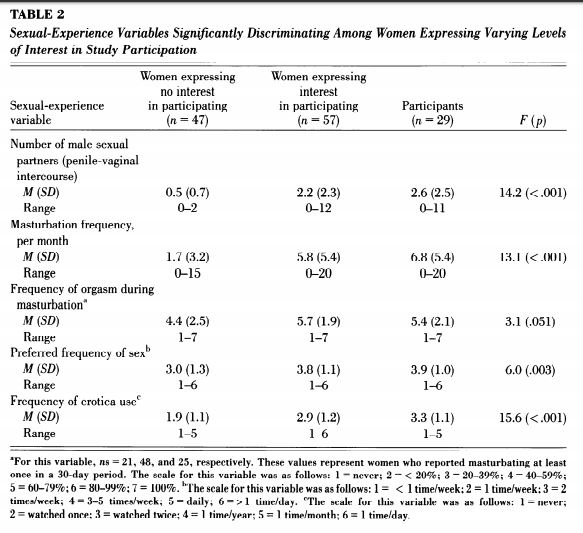
1. They compared the sexual histories of the women that did and did not want to participate, and there was in fact a difference in things like the average number of sex partners, interest in porn, masturbation frequency, orgasm during masturbation, etc. (Table 2 below). This matched what was seen in previous studies on the topic, but the researchers noted that just because there were these differences in experience didn't necessarily mean that those differences in past experience between the 2 groups would translate into different arousal patterns between those 2 groups - particularly different arousal patterns that would disrupt the conclusions made in Study 1.

p742 from A Sex Difference in the Specificity of Sexual Arousal

2. So to find whether women that are uninterested in participating in this study, had they been included, would tend to have an arousal pattern that might disrupt the findings of Study 1,  the researches did some digging into the genital arousal data of the women from Study 2 that were included in Study 1 and correlated that data with their sexual history answers. From there they further correlated those genital arousal / sexual history correlations to the differences identified between the women in Study 1 that did and did not want to participate. [Me: this is were it gets really convoluted. Exactly how these were correlated and combined (not that I would get the statistical maneuvering, but it's not even there for those that would get it), and actual clarity that those were combined in that way are just not in here. I really had to read between lines, and the Table 3 (below) that gives the numbers related to this double correlation (I think) doesn't even have any kind of description or explanation.]

Study 2: Results
For Table 3 below, what I believe those numbers are, are the result of some type of correlation calculation to indicate how likely it is that among the women in Study 1 who were recruited from Study 2 (29 of them total), their arousal scores from each of the categories (M-M vs. N for example) were related to their answers to the Study 2 Questionnaire question on the left. As you can see, the 3 highest numbers down there are marked with * or ** that indicate a p value of less than .05 or .01. The general rule is that a p value of less than .05 means the correlation is a significant one.

Thus, the researchers found from their calculations that only the answers about frequency of orgasm during masturbation, in only 1 category of genital arousal and 2 categories of subjective arousal, would be related to arousal patterns. "Three significant correlations showed that higher frequency of orgasm during masturbation was associated with higher genital arousal to male-male stimuli, higher subjective arousal to female-female stimuli, and more subjective arousal to female-female relative to male-male stimuli. Thus there is no convincing evidence that volunteer bias led to a misleading picture of female sexual arousal patterns."  [me: They don't specifically say this, but I am assuming that the reason they conclude this is because the categories where there did seem to be a significant correlation do not work against the conclusion of the Study 1. For instance, they found that heterosexual women who orgasm more frequently during masturbation also are more likely to volunteer for a study like Study 1.. They also found those same women are more likely to have a stronger genital arousal to the M-M movies. So, knowing this, the researchers could assume that if more hetero females that were not interested in participating in this type of study were nonetheless included, they would tend to have a less strong genital arousal reaction to M-M movies, which would only reinforce the conclusions the researchers already reached in the study - that females don't necessarily have the strongest genital response to the movie exclusively depicting the gender they sexually prefer - the way men and trans women do.]

p742 from A Sex Difference in the Specificity of Sexual Arousal


Discussion and Conclusion

  • "Our findings suggest that women have a nonspecific pattern of sexual arousal that is quite different from men's category specific pattern."
  • The researchers found that males and trans women who prefer men showed significantly stronger subjective and genital arousal to erotic movies depicting exclusively men and the opposite was true for males and trans women that prefer women. For both straight and lesbian females, this was not true. Both groups showed genital and subjective arousal responses only modestly related to their preferred sexual partner category.
  • They believe this could not be related to volunteer bias (the idea that women who don't want to participate in a study like this, if included, would skew the overall data differently), because of the conclusion they found from Study 2.
  • They also don't believe this difference could be due to the different ways the genital arousal was measured in males and female because trans women showed similar patterns to males even though they were measured the same way the females were. It is of note as well that trans women followed male patterns also in subjective arousal responses.
  • The researchers do not believe that although females seem to show arousal to all types of people, that this means they are not the sexual orientation they believe themselves to be. They note that despite female ability to be aroused widely, women do not participate in homosexual activity more than men.
  • "A self-identified heterosexual woman would be mistaken to question her sexual identity because she became aroused watching female-female erotica; most heterosexual women experience such arousal. A self-identified heterosexual man who experienced substantial arousal to male-male erotica, however, would be statistically justified in reconsidering his sexual identity." 
  • "Our results cannot directly address whether sex differences in category specificity of sexual arousal is innate or learned. Our findings that male-to-female transsexuals show a male typical pattern, however, helps to rule out some explanations. Women's non specific pattern might not be fully explained by their lack of visible genitalia because transsexuals show a category-specific pattern despite a similar lack." [me: besides there being a lot here to unpack about assumptions related to the physiological qualities of trans people and about how and when trans people develop sexual identities and patterns, there is also a simple note that although the post-operative trans women in this study do not currently have genitals where arousal is easily noted, they almost certainly did all through their adolescents when many sexual patterns may have been ingrained. How they related to their genitals compared to cis men and women might be a whole other story, but I think it's a bit disingenuous to use their current situation as evidence that lack of genital visibility isn't likely influential in arousal patterns.]
  • The researchers again note a possible limitation of their study - that using the "pure stimuli" of movies showing homosexual acts might be offensive or bothersome to some (homophobic) heterosexuals, and this may be a weakness of their study. They think another study that did not use homosexual acts, but instead maybe solo sexual acts might be useful.
  • They say a second limitation is assuming that participants weren't consciously controlling their genital arousal . They point out a study where some males were able to do that. However they think this is unlikely for a few reasons. They pointed to another study where males who had a strong reason to control their genital arousal (during penile arousal assessment for pedophilia) could not. They also note that studies have shown males can lessen their genital arousal response, but cannot increase it. So, "although heterosexual male participants might be motivated to suppress sexual arousal to male stimuli because homosexuality is stigmatized, gay men would not be similarly motivated to suppress arousal to female stimuli; yet gay men's arousal was also category specific."
  • The paper concludes with: "The sex difference reported here has important implications for future conceptualizations of women's sexuality. Sexual arousal, especially genital sexual arousal, likely plays a much smaller role in women's sexual orientation development than it does in men's. Female sexuality, in general, may be more motivated by extrinsic factors, such as desire to initiate or maintain a romantic relationship, than by intrinsic factors such as genital sexual arousal (Baumeister, Cantanese, Vohs 2001). This basic sex difference in the role of sexual arousal processes highlights the need to use distinct models when investigating the development and expression of female and male sexuality." [me: or, and hear me out, the differences identified in this study may be an indication of how very different sexual culture, sexual experiences, and sexual imagery are for females than they are for males. This may an indication that what we think of as the common sexual experience is really the male sexual experience and what we understand to be common sexual imagery is actually deeply male-centric sexual imagery]

Some of my own thoughts
I appreciate any study that shines a light on the realities of how sexual things tend to work in people. I think there are useful things to be gleaned from this. Ladies (and really all people because there were people in the other categories that didn't perfectly align either - just less of them), just because your genitals are getting all swollen and wet in a situation doesn't necessarily mean you're actually interested in being part of something or that you are/should be mentally excited about it. Same if you feel mentally aroused, but your genitals are dry as a bone. It doesn't mean you don't want to be a part of something. Those 2 things may not always match up. That's the reality, and it doesn't mean you're broken. They are merely clues to pay attention to and help inform your decisions.

I also think it's useful to know that in the situation set up in this study, the participants reacted the way they did. I believe that knowledge could be the start of some digging that brings about even more interesting knowledge. What worries me though is both the specifically expressed and the underlying assumptions about why the results turned up like they did. What I see in this study is the researchers making a conclusion about how females, by their very nature, experience and express our arousal and sexuality. Even though the researchers specifically point out they can't say for sure if it's innate or learned, I feel that the tone of the article leans to innate, and this study is often used as evidence of the innate male-female differences in arousal pattern. However, I think one has to overlook a lot of cultural shit and a lot of realities of human sexuality to assume in any way that this study could be a look into the innate nature of female sexuality. And, I think it's a little bonkers to assume that this experimental design puts males and females on any kind of level playing field for sensible comparisons to be made.

I have a lot of reasons why I think this absolutely does not give a fair, even handed assessment of males vs. females. It is not a level study design even though on the surface, it may seems to be. For your reading enjoyment, below is a list of things off the top of my head that I believe affect and likely skew the outcome of this study. I completely understand that it's hard in a study to control for all the things in our world that affect the human experience. However, I think that these are large variables, yet weren't even considered in the experimental design and weren't discussed as possible limitations to the study. That, I can only assume, means the researchers either didn't consider them or didn't consider them important enough to discuss. Which in turn, I believe, means the researchers think this study was much more objective than it actually is, and that's a problem.

1 Sexual Experience Differences
Orgasm, people. Females orgasm in couple situations so much less than males. The female relationship to sexual activity is deeply different from the male relationship for this fact alone. I won't go into details because it's a lot and I already have tons of posts in this blog that describe how and why women don't orgasm during sexual activity even though our bodies are no less capable than men's (for instance: stimulation inside the vagina as one might get from intercourse is not stimulation that causes orgasm in females; all of media seems to insinuate it is, though, and that women should orgasm from getting banged; sex ed sucks and the clit is ignored, etc.). But the point is, to males sexual activity=orgasm and that's not true for female.

Consider a female and a male that have about the same amount of sexual activity in their lives, but realistically the male will come about 90% -100% of the time, and the female may only comes 30-70% of the time (if at all). In this case (which is not an uncommon case), sex itself is a different thing to each of those people with different expectations and associated feelings. Would it be crazy to assume that the male in that situation be more quickly and strongly aroused by things related to the sex they've had in their life, since those things seem to always lead to orgasm? Would it be crazy to assume that the female in that situation has much more complicated reactions to things related to the sex they've had - a mix of arousal, boredom, frustration, obligation - maybe it's more associated with love/romance/relationship than to eroticism and arousal - given that sexual activity doesn't always mean orgasm for her?

2 Porn, man. 
Different groups of people have very different histories, experiences, and baggage related to porn, and I'm not saying that in the 'individuals have individual experiences' kind of way. I'm saying that in the 'porn as a whole is acutely focused on male desire, orgasm, and fantasy, yet we largely ignore that and naively expect other people to glean the same experiences and feelings from it - which is utterly insane' kind of way.

The researchers in this study clearly don't get this because they don't acknowledge that this could be a limitation of their study. Also, there is no detailed descriptions of what the porn they show is like (what the people looks like, the intensity level, how it's shot-angles/close-ups, the sound and film quality, are there reach-arounds during the penetration scenes?). They only mention what type of sex act and whether the actors are male or female. There is not even a mention that the researchers took into consideration those details.

 Let me just list out some elements of porn (and I mean mainstream porn that you might easily find on any videotape or streaming site) that cause it to be such a different experience for females vs. males. I honestly don't know how to contextualize these things I'm saying for the trans experience, but they certainly are a part of it, and I'll leave it to people who know that experience better to pick through.

  • Females generally don't orgasm in porn. They moan and scream and fake a lot, but they barely come ever. Males, whether gay or straight, come almost 100% of the time. Imagine the difference in watching something where the people like you are having sexual things done to them that literally don't lead to orgasm. Whether you watch it and see the faking as faking or you assume it to be real and try to fit that incorrect depiction into your own expectations and experience - either way you have a very different relationship to it than people who watch it and see things happening to people like them that lead quite specifically to orgasm. Also just consider what males glean from porn about female sexuality and females about males sexuality...and how deeply seated and complicated those understandings are.
  • Mainstream porn (both gay and straight) is by and large focused on the needs and wants of the male viewer. Note the orgasm situation discussed above, but also it's how the people are positioned and how they look, and how they interact, what angles the camera gets. It's a little strange to me that the researchers didn't consider that there is a difference in porn depending on what kind of viewer it's focused toward. However, they probably didn't think about that because as a society, we don't think of it. Hetero porn is touted as porn that's made for both hetero males and females, but it's not. It's largely made for the male viewer, and it's rarely admitted. I really think it's incredibly naive and blind to assume that hetero porn made specifically for the male viewer would be as arousing to the female. Equally, why would gay porn made for males be as arousing as gay porn made for hetero females or lesbian porn made for the male viewer be as arousing for the lesbian? That the researchers had no worries that the very same male-male film might get a different reaction from gay men as it did from straight women, reveals a significant blind spot in the experimental design. 
  • Porn is, let's be honest, sometimes incredibly gross, boring or painful for the female actors in a way it is not for the male actors. Even if the porn clips in this study were not that way, it is very likely that at least some of the previous porn the participants have seen was this way at least some of the time.  Like, there is not an insignificant amount of mainstream (we're not talking BDSM or niche porn - just basic hardcore) where a woman gets slapped; on her face, her ass so hard she gets red welts, her pussy. Also, ladies often get loads blown in a pretty distasteful way on them. Often, the cunnilingus they get looks silly and not like it would work for orgasm at all (and it doesn't, so..). The way dudes touch the pussy is often cringy too - like way too rough or pulling it in weird ways.  And, sometimes (often?) the fucking looks really painful - like she's making noise and squirming, but any woman that has had a dick hit her cervix knows it's really just her dealing with the pounding until it's done. Even if the female participants use and enjoy porn - even if they like porn like I just described, it's still part of the baggage they carry in their minds about porn that men largely don't, and it very likely has some kind of differing effect on how their mind and body reacts to porn or the idea of porn..
  • Can we remind ourselves that the researchers chose a sex act that would lead to neither females orgasming for one of the F-F clips? Two women fucking with a strap-on. Like, why? I mean, I know that this is a thing some lesbian couples dabble in, but unless there was also a bunch of clit stimulation included (and the researchers certainly didn't mention a reach-around was involved), it's just a really strange mimic of something dudes like to do with women because it makes their dicks come, but is kinda useless for the ladies involved (almost like it's a show for male hetero dudes, huh?). It's a little weird and male-centric a thing to have in this study. 

3 Body Image
I don't know exactly how this might affect the outcome of this study, but there is truly a difference in how female vs. male bodies are depicted in our world. Female bodies, even very young female bodies are made to look sexy. The camera looks at them with angles the emphasize the ass and boobs. Clothes, even professional and casual clothes show much more skin than male clothes tend to. Females in general put more effort into looking sexually attractive, with make-up and hair styling and shaping underclothes. Female nudity in movies tends toward sexiness and male nudity tends toward comedy. I imagine for both males and females, sexual/nude images of males have a very different connotation than sexual/nude images of males, and on top of that those images affect both how we see our potential partners and how we imagine and understand ourselves. The way those things interact differently for different genders and different sexual preferences is complicated, but something to consider when using sexual imagery to compare these different people.

In Conclusion, Ya'll
I mean, I think using body and mind reactions to porn as a way to get an equal comparison of males vs. females is like using reactions to movie scenes of murder to compare horror directors and war survivors equally. I'm not trying to make a 1:1 comparison between males/females and horror directors/war survivors. I just want to point out that males and females are 2 groups that have very different perspective on sex. Even if it's not something that is discussed or even recognized in society, it doesn't make it any less true. It's naive to use moving images of sex and assume reactions from males and females can be compared 1:1. The results will be skewed - and that's without even considering how complicated a thing like sexuality is on an individual level.

5.02.2020

Ejaculation Associated With Bladder Muscle Overactivity? - A Journal Article I Read


Well, my friends, this is another installment of A Journal Article I Read - a segment in which I read a lady-gasm related peer-reviewed journal article and try my damndest to summarize the article here for you without taking away too much of the detail and subtlety, yet making it readable and not too long. I do my best to achieve those goals, and that's all I can say.

In these summaries, you can assume that anything I write is a genuine attempt to reflect what is said in the paper - even if it's shortened or summarized. My opinions, if I have any to add will either be inside brackets likes these [me:], or in a section headed in a way that clearly lets you know these are my opinions. All quotes are from this article unless specifically noted.

You can check out the list of all the past 'A Journal Article I Read' Summaries HERE.

Do women with female ejaculation have detrusor overactivity? Cartwright R1, Elvy S, Cardozo L. J Sex Med. 2007 Nov;4(6):1655-8.

My Quick Summary
In order to identify if bladder abnormalities (specifically problems with bladder control) tend to exist in women that claim to ejaculate during intercourse and/or orgasm, the researchers (who have a urogynecology practice) investigated 6 women that claimed to ejaculate and 6 women who claimed to have never ejaculated. They had them fill out a 3-day journal of their peeing situations, and they also did a test where they filled their bladder up and checked to see if they could hold it while doing things like coughing. What they found was that none of these 12 women had issues with bladder control. Although in their practice they have identified some women who they believe misidentified their bladder control problems during sexual activity with ejaculation, this study showed that not all women that claim ejaculation also have bladder problems. They conclude that if women have liquid release during orgasm or intercourse but do not also exhibit other symptoms of bladder control problems, then there need to be no more medical investigation, and these women should be assured that their release is not a problem.

I think this is a really simple, thoughtful, generally well-done study. Although it's quite small and specific, I believe it adds 1 tiny drop into the already quite small pool of knowledge that can be used to help piece together an understanding of sexual fluid expulsion. I also appreciate that this study does not seem to push any agendas and doesn't carelessly confuse ejaculation with orgasm - because they are not physiologically the same thing.

Introduction

  • "Questionnaire surveys have suggested that 40% to 54% of women have at some time experienced an expulsion of fluid at orgasm [1,2]." There have also been references to female ejaculation throughout history and in more recent discussions by Dr. Graffenburd in the 50's and Beverly Whipple in the 80's who "reported that a minority of women passed small volumes of fluid during heightened sexual arousal or at orgasm."
  • "Although it is anatomically and physiologically plausible that small volumes of fluid might be expelled from the para-urethral Skene's duct, some sources imply that it is a normal part of female sexuality to discharge large volumes of fluid at orgasm." [Me: "Skene's gland is said to be the female prostate since it is the embryological, yet less developed, equivalent to the male prostate. It wraps around the urethra and can sometimes be felt through the vaginal wall towards the front of the body in the area that is most commonly called the G-spot (although G-spot is also used as a catch-all phrase to describe an imaginary button that causes vaginal orgasms).]
  • The authors go on to describe how now there 'ejaculation gurus' that try and teach women to ejaculate and porn that shows large volumes of fluid expulsion. "The most anatomically and physiologically plausible explanation is that such fluid is emitted from the bladder."
  • Maybe partially because of those misleading depictions in porn and the like, it remains controversial what the liquid at ejaculation is - urine, prostate fluid, vaginal secretions, a mixture of the two?
  • There are some past studies, but many of them have small sample sized and some are not peer reviewed.
  • Some studies showed higher levels of prostate enzymes than would be expected in urine
  • One study catheterized 7 women who claimed to regularly experience ejaculation. For all of the women, "large volumes of fluid were passed down the urethral catheter, with the timing of fluid expulsion corresponding with the peak of orgasm." [Me: So, in other words in this study there seemed to be liquid coming from the bladder during sexual arousal even though the bladder had been emptied beforehand].
  • In the author's urogynocological practice, they often treat women with bladder control issues. A previous study has indicated that orgasm can cause a detrusor (muscle on wall of bladder) contraction that can cause leakage, and women who complain of leakage at orgasm have a high prevalence of detrusor overactivity. However, symptoms of detrusor overactivity do not only include leakage at orgasm or intercourse, but also other bothersome things like urinary urgency and frequency.
  • The authors, as female ejaculation has become more commonly known, have treated women with a proven detrusor overactivity diagnosis who rationalized the leakage at orgasm as ejaculation. So from this anecdotal evidence, they wanted to see if they would find a connection between ejaculation and detrusor overactivity - and particularly wanted to see if women that self identified as ejaculating also showed this bladder condition. This was not meant to stigmatize but to help counsel women who presented leakage at orgasm and also to maybe better understand the physiology of ejaculation.


Subjects and Method

  • 6 participants that self-identified as having experienced female ejaculation and 6 that had not were recruited from the researcher's institution staff. They were between 27 and 41 and having given birth between 0 and 3 times.
  • They were given a short survey asking about frequency and conditions of ejaculation. All 6 of the 'ejaculating' women said they ejaculated either "often" or "sometimes" and did so either during masturbation or intercourse.
  • "Each women completed a 3-day bladder diary, documenting the volume and timing of urinary void."
  • Each woman also completed 2 short validated bladder questionnaires; one asking about perception of desire to void and the other asking about bother associated with lower urinary tract symptoms.
  • Each woman also underwent 'short provocative ambulatory urodynamics." This is basically a test for detrusor over-activity where a catheter is placed up the urethra and anus, and the bladder is fully filled for about 30 minutes while the participant is asked to do things like coughing and heel bouncing while holding their pee.
  • Data was analyzed by a blind 3rd party. There was no difference between the groups and so no extra statistical analysis was performed.


Results

  • There was no indication of detrusor over-activity in either group and the bladder-diaries showed no significant difference between groups.
  • There was no significant difference between the scores on the validated bladder questionnaires about desire to void. "Almost all the women agreed with the statement, 'I am usually able to finish what I am doing before going to the toilet.'"
  • The scores for the validated bladder questionnaires about bother associated with lower urinary tract symptoms were "marginally higher (more impairment) in the female ejaculation group." This was due to 2 women in that group who had given birth that "reported occasional bothersome stress incontinence."


Discussion

  • "This study does not exclude the possibility that female ejaculate is coming from the bladder. It does however, demonstrate that women who report female ejaculation do not necessarily have the associated symptoms or pathophysiology of women who complain of coital incontinence."
  • This research did not replicate the "symptoms" of an ejaculation. The women were not sexually aroused, so there is still a possibility that for the ejaculating women there is uninhibited detrusor (muscle of bladder wall) contractions at orgasm. A future study in this vein, but with women during sexual arousal and orgasm would be useful and informative.
  • Like most female ejaculation studies, this sample size was small, and it is possible there was bias in that women who had incontinence issues may not have volunteered for the study.
  • The researchers also wonder if there could be bias because the ejaculating women in this study did not necessarily experience it frequently. Other past studies have used women that were able to ejaculate at most episodes of intercourse or masturbation.


Conclusions
"Based on our findings, we would recommend that women who report female ejaculation, in the absence of other bothersome lower urinary tract symptoms, do not require further investigation. They should be assured that this is an uncommon, but physiological phenomenon."

4.17.2020

Where Does Touch To the Clit Activate In The Brain - A Journal Article I Read


Welcome back to 'A Journal Article I Read,' a series where I summarize a lady-gasm related journal article in a way that is hopefully both comprehensive and also not too long. You can find a list of all the journal articles in this series HERE.

Here is what I'll be summarizing today.

The Somatosensory Representation of the Human Clitoris: An fMRI Study 
LarsMichels, UlrichMehnert, SönkeBoy, BrigitteSchurch, SpyrosKollias
NeuroImage 2010 Jan. Vol.49 Issue 1, p.177-184

And lucky you, you can find this full article HERE, so if you're into fMRIs and know some shit about that stuff, you can get the full details there.

Quick Summary
The researchers here are trying to identify where in the brain clitoral stimulation activates. There was a famous study done about 80 years ago that identified where stimulation of different body parts activated the brain. It had a place for the genitals, but there's been a lot of disagreement on that since.  Some more recent studies have used fMRI to identify a different area of the brain related to penis stimulation than that original study, and this study hypothesized the clitoral stimulation would activate a similar area using fMRI. They tested 15 women by putting electrodes on either side of the clit and giving them a gentle electrical pulse while in an fMRI machine that takes particular types of pictures of the brain. For 8 of these women, they also did the same thing, but this time the electrode is on their right big toe (which they refer to as the hallux). They use this as a type of control because in that original old study, foot/toe area was said to activate the brain very near where the genitals were said to. However, these researchers did in fact find that stimulation of the clitoris activated a similar area to where the more modern fMRI study showed activation from penis stimulation. It was also different from the area of activation from the toe stimulation, even though the original study showed the toe and the genitals quite close.

**I will from now on just be summarizing to the best of my ability, what is actually said in the article. If I want to give you my opinion, I'll clearly mark it with a heading or in a [Me:...] parenthesis. Things in quotes are actual quotes from this article.**

Introduction
My quick description of this old study they reference a lot
Okay, so this old study, by Penfield and Boldray from the scientific journal Brain in 1937 which I will refer to from now on as P&B 1937, was about mapping the somatosensory system on the brain. They did the mapping by using electrical stimulation on the brains of people undergoing open brain surgery for control of epilepsy, and continued doing the research for years after. My understanding is that they stimulated areas and asked the awake patients where they felt the stimulation in their body. Through this, they created an incredibly famous and much used depiction of the human body on the brain (the somatosensory homunculus which you can check out below). The size of the body part represents the density of the receptors in the brain for that body part and not necessarily the size of the brain area where the receptors are. Also notice that the genitals are right next to the toes.


homunculus picture from EBN Consult (which is a cool site to get free core medical education information)

Okay, now the actual study intro
  • P&B 1937 has been "virtually a standard reference for various somatotopical studies" for the last 70 years.
  • P&B 1937 "relied on reported sensation of different body parts after electrical stimulation of the cortex. Assessment of the exact location was generally difficult and sometimes led to conflicting results."
  • "The genital region was especially hard to assess due to difficulties with sense of shame." The location of genital sensation has been subject to lots of discussion and conflicting results over the years. Penile representation has been reported from some studies in the mesial wall as expected from the P&B 1937 and in other studies in the lateral surface of the postcentral gyrus using fMRI.
  • Though it's fair to assume the clit would be represented in the brain in the same area as the penis given that they are anatomically homologous, little has actually been studied of it. A 1991 study showed the penis represented in the inter-hemispheric fissure, "though they were not able to distinguish it's location from that of the posterior tibial nerve," which these researchers say makes sense because of the low spacial resolution of the type of testing done in this study. There was also a 2006 study (that I summarized HERE) about brain activation during orgasm caused by manual clitoral stimulation that howed the activation area in a somewhat different area.
  • Based on recent studies of penile sensation, the researchers hypothesize they will find clitoral stimulation on the lateral surface of the postcentral gyrus (not the mesial wall as predicted by P&B 1937).
  • The researchers also believe this is an important line of study because electrical dorsal genital nerve (i.e. dorsal clitoral nerve) stimulation emerged as a promising therapeutic approach for improving neurgenic and non-neurogenic lower urinary tract dysfunction such as sphincter weakness or overactive bladder." [Me: I can't help but imagine that the researchers had to throw in this link to medical relevance for research grant purposes, because, I think, getting money and permission to do research simply for research sake - especially related to sex or genitals, is not a smart or easy bet.]

Materials and Methods
  • 15 right-handed subjects (22-34 years old) were tested. Subjects were not pregnant and had no medical, mental, surgical, or drug-related issues that might interfere with the test.
  • To ensure privacy, a trained female assistant attached the electrodes to either side of the clitoral glans "so that they were able to stimulate the fibers of the dorsal clitoral nerve," behind a curtain and then the subject wore pants over it and a blanket. They were also alone in the room when the test was taking place, and their names and data were kept anonymous. [Me: I assume they were careful about privacy because they felt a problem with older studies was related to shame over genital sensation. Also note this study happened in Zurich and the truth is orgasm and clit studies almost always happen not in the USA]
  • Before the experiment electrical tests were performed to make sure the subject could feel the stimulation directly on their clitoris. The strength of the electrical stimulation was also set specifically for each subject so that it neither was painful nor elicited sexual arousal [Me: But, I mean, it's on the clit, it'd be hard to not feel a little sexual, right????
  • fMRI images were created using a Phillips Achieva 3.0 MT R Scanner. It lists out the settings, and if you are interested in them, then please do checkk out the full article linked up top.
  • The scan began for each subject with 18 seconds of rest then 12 seconds of electrical stimulation. This altering between rest and stimulation happened 10 times, for a total scan of 5 minutes for each subject.
  • For 8 of the subjects, a 2nd experiment was also preformed in which the same type of electrodes were put on the right toe instead of the clit. The rest/stimulation altering and scanning were set up the same.
  • The researchers also assessed the discomfort and the sexual arousal caused by the electrodes by asking the subjects to use a Visual Analog Scale. [Me: The scale for pain you often see in hospitals is a Visual Analog Scale - see below]. "the scale ranged form -10 (e.g. unbearable pain) to 10 (e.g. pleasure). For sexual arousal, the scale ranged form -10 (strong sexual arousal) to 10 (no arousal at all/sleepiness).
  • 2 subjects had too much head movement to use the data, so their data was thrown out of the study, leaving 13 subjects in the final results.
  • There's information about the software used and how the images were aligned, etc. Again, if you're interested and know about that, check out the link to the full article up top.
  • [Me: Again - a lot of information about how the resulting data was complied and analyzed. I do not have the expertise to relay any information about this to you except copy what was written, so I'll just give the big-picture stuff that I basically understand.] The images during rest were compared to images during clitoral stimulation, and for the 8 subjects who also took part in the experiment with the big toe stimulation test - the images during rest were compared to images during stimulation of the big toe.
  • Potential affects of the co-variates (sexual arousal or discomfort) on the brain were assessed statistically as well - in order to see if that may affect activation areas in the brain.
a type of Visual Analog Scale (VAS)

Results

  • The median Visual Analog Score (VAS) for sexual arousal was 0 (which is right in the middle of strong sexual arousal at -10 and none at all at 10). The median VAS score for discomfort was -2 (which is a bit closer to unbearable pain at -10 than the rating of pleasure at 10).
  • "Electrical clitoral stimulation produced significant activations predominantly in bilaterally prefrontal areas..., the precentral, parietal and postcentral gyri...In addition distributed activations were also seen in the anterior and posterior parts of the insula and the putamen. This activation pattern was seen in most of the single subjects and therefore also on the group activation map."
  • "Most importantly, we found no activation on the mesial surface of S1 on either side even when using unconventionally low thresholds. [Me: So didn't find what P&B 1937 found].
  • [Me: There are then 2 paragraphs about specific coordinates of activation for both clitoral stimulation and toe stimulation. It's too complicated and technical for me to understand or summarize. That's the truth.]

Discussion
  • The P&B 1937 study placement of genital activation in the brain has been more or less unchallenged for over 70 years, and lots of theories have arisen about why it is as it is. For instance, there is an idea that the feet and the genitals as well as the hands and the face are represented in the brain so close together because during development in the womb, the fetus' feet are tucked up near the genitals and the hands are up near the face. Only in recent fMRI studies have the penis representation been shown in another location.
  • The researchers used electrical rather than air pressure or touch-with-brush stimulation for a variety of reasons including that it's easily attachable to the clit and it's easier to adjust the stimulation.
  • The researchers found stronger activation in the left somatosensory cortex for the clit stimulation, which they found odd because the clit was being stimulated from both sides. They suggest this could indicate a left-hemispheric dominance of clitoral representation in the brain, although they admit they have no convincing explanation for that.
  • They found no evidence for clitoral representation on the Mesial wall like the P&B 1937 study suggested.
  • The representation of the big toe was along the mesial wall and thus different from the clitoral representation.
  • There is overlapping activity in the operculum (O1-O4) regions, which has also been found in other studies. The researchers do not believe this is a result of discomfort or surprise related to the electrical stimulation, but to the stimulus itself
Conclusion
"In contrast to previous studies using SEPs that were not able to clearly discriminate the location of cortical sensory representation of the genitals in humans, we found a significant activation on the convexity of the postcentral and inferior parietal cortex (S1 and S2) for electrical clitoral stimulation. These findings support the assumption that the S1 representation of the clitoral afferents may be different from the somatosensory homunculus introduced decades ago. The distinct activation locations for the central representation of the clitoris and the hallux indicated that fMRI and electrical stimulation can be used to study the specific organization of small body areas and their somatosensory representation in humans. Apart from its scientific interest, the precise location of the genitalia in humans may have important implications for studying cortical reorganization patterns in various urogenital, sexual and neurological disease processes."