I know you want to know about more Journal Articles I Read. So, I will give that to you. Today we have:
Pilot echographic study of the differences in clitoral involvement following clitoral or vaginal sexual stimulation.
Buisson O1, Jannini EA.
J Sex Med. 2013 Nov;10(11):2734-40.
Overview
This is a worthwhile and interesting investigation. It doesn't though, give us any real insight into vaginally activated orgasms - not what they look like when they happen or if they really do happen, but it is a step in the right direction for further investigation.
Basically 3 women, all medical doctors (I don't know why, but there seems to be a trend in using medical doctors for these human lady-gasm studies. It must be easier to use doctors for some reason) who claim to orgasm both through vaginal and through clitoral stimulation, volunteered to stimulate their outer vulva/clitoral area and then also their vagina while their insides were being recorded using ultrasound technology. Turns out, when these women were stimulating their clitoral glans, only the glans and the raphe get jostled (*I have actually never heard that part called raphe before. I generally see it called the shaft - the part, about the circumference of a pencil, that extends back from the glans and can be felt by rolling your finger back and forth just above the clitoral glans. In fact the only other time I can find it called a raphe is in another ultrasound study by these exact 2 authors. We'll use their vocabulary though to keep things consistent). The inner clitoral parts aren't jostled at all. When these women stimulated their vaginas by moving an object it in and out, the clitoral body (I often see these parts called the clitoral legs or crura, but we'll use body) were jostled along with the raphe. The glans was not jostled. This led the researchers to conclude that the two different types of stimulation might explain why women describe 2 different types of orgasm.
 |
| From ScarletTeen:sex ed for the real world http://www.scarleteen.com/article/bodies/with_pleasure_a_view_of_whole_sexual_anatomy_for_every_body |
And before I go on, let me just put a disclaimer here. I can't read ultrasounds. I don't fully understand how they could identify the movement in these women's lady parts. The pictures just kinda look like unidentifiable blobs, and so I am just reporting and accepting their findings exactly as they describe them.
Introduction
The intro tells us male orgasm is pretty well understood, but female orgasm is controversial. It concedes that undoubtedly most women need external clitoral stimulation in order to orgasm, but then gives a wildly high estimate for the amount of women who can orgasm vaginally, saying around 60 to 70% and citing a debate article on the G-spot that is in no way a good reference for that number. A widely agreed estimate (and Lloyd's book, The Case of the Female Orgasm is probably one of the best researched authorities on this out there if you want to check it out) is about 2/3 of women who cannot orgasm vaginally.
The authors later in the intro give us a little bit of their bias, I would say, when they say, "Moreover, the existence of a 'vaginal' orgasm (more correctly named "vaginally activated orgasms," VAO) has often been rejected, more for political than for scientific reasons," and backs that statement up by citing that same debate article. Both the authors of this article actually co-author that article 4 other people. It's called, "Who's afraid of the G-spot," and the 7 different scientists debate the existence of the G-spot in terms of the data presented thus far, and the conclusion of the piece is...we need more data. First off, the article is about the G-spot and not about VAOs. Secondly, that article in no way supports a claim that politics are a bigger factor than scientific data for rejecting the idea of VAOs. I'm getting heavy into the intro stuff here in this article because I'm just starting to get a annoyed with the citations authors use in some of these articles to support the claims they make in their introductions. It's like they are putting no thought into it - like what I would do writing some stupid paper in high school or college where we were told to have a certain amount of citations. I'd just find anything that kinda included the same keywords I was speaking about and put it in there as support for whatever it was I was saying.
Also, in the introduction, the authors tell us about VAOs, "Furthermore, this type of orgasm is sometimes considered to be associated with better psychological health than the orgasm triggered by external stimulation of the clitoris." I will grant that the 1 book and 2 articles that are cited for this, do indeed argue this, so at least they are using relevant citations there. However all three works have a strong Freudian influence and then this article goes on to mention that
1. Freud made a claim that VAOs are mature and clitoral orgasms are immature
2. "Kinsey and many sexologists have asserted no such link"
3. but there's actually not a lot of data about whether that's true or not
It just makes me wonder why this Freudian stuff is brought up at all in the introduction for this article. He was just a dude that had some idea. His ideas about female orgasm had no scientific base, so it boggles my mind that orgasm scientists continue to discuss it like it has some scientific validity that needs to be taken into consideration. I can see why one would want to discuss that there is controversy about whether there really is 2 separate types of orgasm, as Freud suggested, since some women do claim this to be the case, and that this study may help clear that up. However, talking about VAOs causing better psychological health is so Freudian inspired and so not even remotely related to the contents or possible insinuations of this study and its results. Honestly, it makes me really wonder whether the authors are truly just interested in learning more about women's bodies during sexual arousal and orgasm, or whether there is also some type of larger interest in validating Freudian thought on female orgasm....and if that's the case, then I think there is some extra bias that should be considered here.
Method
- The 3 women were medical doctors between 27 and 33, never had babies, healthy in body, and found to be sexually healthy after taking the Female Sexual Functioning Index questionnaire.
- None reported releasing fluid during orgasms (so no ejaculators/squirters in the group)
- All "claimed to a achieve vaginal orgasm during coitus without external clitoral stimulation. As previously described, we mean by VAO the orgasm experienced after direct stimulation of the anterior vaginal wall by penetration, without concomitant stimulation of the external clitoris." So...these 3 doctors could pop off from a straight up bone-ing that included absolutely no touching of the outer clit area.
- The women were all in the normal gynecological position during the study
- They used a Voluson sonography system and a 12-MHz flat probe and a vaginal probe
- "To ensure good skin contact, the vulva was covered with a sufficient quantity of sonographic gel to avoid possible interference from air between the labia. The probe was placed sagittally on the Labia majora to obtain a sagittal scan, because when a volunteer's hand is stimulating the genitals it is difficult to obtain coronal or transversal views". (I honestly cannot visualize how this was set up because I can't really figure out how the sagittal view that they get below happens from placing the probe against the labia majora, but I imagine this is just because I've never done this type of work before, and if it makes sense to you, please let me know how to understand it better.)


 |
| So, this is the view they got, it really seems to be fully sagittal, so again, if you can imagine how the flat probe was placed on the labia majora to get this, give me your insight. |
- A wet tampon was placed in the vagina. It was useful because it clearly marked where the vagina was in the ultrasound. It stayed in the vagina during the external stimulation and was the object used to stimulate the vagina during imaging of the vaginal stimulation. It was used instead of a dildo because it produced less shadowing in the ultrasound. It was "sufficiently rigid to stimulate the vagina"
 |
| More sonograms from the study, but with the wet tampon in this time. |
- There were 2 sets of experiments. In the first set, the subjects performed stimulation externally and internally each for exactly 5 minutes. In the second set, the subjects could stimulate themselves for as long as they needed to orgasm. "However, echographic evaluation was always performed before orgasm, when the subject felt sufficiently aroused." Echographic is basically another word they use for the the ultrasound technology in this study, so...the orgasms simply were not recorded for some reason that is not discussed.
- The authors tell us that the time to reach orgasm through vaginal stimulation took longer than through clitoral stimulation, but ends that sentence with (data not shown). They give no reason why it is not shown.
- Each volunteer replicated the experiment at 4 different sessions, inverting the order of stimulation (clitoral stimulation first vs. vaginal stimulation first).
- They authors warn of a possible but not too likely issue that could have occurred during that vaginal stimulation portion. "the finger, pushing the tampon, could have inadvertently have touched and stimulated the clitoris, urethral orifice, and periurethral glans; this could be regarded as a possible limitation of our technique. however, we and the volunteers paid close attention to avoid any contact with the external clitoris and the urethral meatus during the experiment."
- Another measure was taken during the time the women were stimulating their genitals. "Color Doppler scans of the veins located at the junction of the cavernous bodies and the vagina were obtained, and velocimetric data were collected twice for each subject."
Results
- The sonogram showed three parts of the clitoris which the authors describe as the glans, raphe, and body.
- The vestibular bulbs could not really be visualized in this study because limitations to the placement of the probes.
- External stimulation jostled the glans and the raphe, but not the body, and the wet tampon in the vagina didn't seem to move (except in the case of voluntary perineal contractions).
- Internal stimulation showed something different, "during vaginal stimulation, when the tampon was pushed upward, the clitoral body slid down (figure 3). The pushing of the tampon elicited reflex perineal contractions, that together with the voluntary contraction, generated a descending movement of the cavernous body. On the sagittal scan, the root of the clitoris was seen descending and making more contact with the anterior vaginal wall."
- "Color Doppler scans showed that the flow velocity in veins located at the junction of the cavernous bodies and the vagina was enhanced at each contraction and after 3 minutes of vaginal stimulation...The same vascular reaction was not seen during external stimulation of the clitoris."
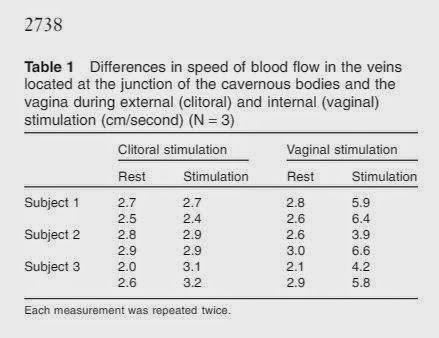
- The vascular and anatomical changes were comparable across all 3 volunteers.
- "In all sessions, when proceeding further with the externals or internal stimulations, the volunteer was able to reach orgasm or VAO respectively (data not shown)." So, again, it apparently happened, but they don't really want to talk about it.
Discussion
- The authors say that both bidimensional and Color Doppler ultrasound are a "useful tool for conducting dynamic imaging studies of female genitalia during sexual stimulation."
- They again describe the different ways the the lady innards moved in response to vaginal and external stimulation, and then propose that the different stimulations and body movements that vaginal vs. external stimulation elicits could be the explanation for why women describe two different orgasms.
- They go on to say, "Our study was limited to ascertaining anatomical changes during arousal due to different types of stimulation. Further studies are ongoing aiming to correlate functional anatomy with different types of orgasms."
- They tellus that it is possible anatomical difference in women, including relative position of that vagina and clit could make be important.
- They also believe this study is further evidence that the g-spot is not a "single, discrete area of nerves" but rather a "complex anatomical area encompassing the anterior vaginal wall and the embedded structures (urethra, female prostate, inner clitoris, muscles, vessels, and nerves) that my functionally stimulate the whole clitoris when properly stimulated." They think this whole area should be called the CUV instead of the G-spot. *The best evidence out there for a G-spot, however, does not indicate that it is a "single discrete area of nerves" at all actually. The best and most robust evidence out there indicates that it is the area in the vagina where the female prostate (which wraps around the urethra) can be felt through the wall. It also indicates that ejaculation can be elicited but not orgasm. Again, the word G-spot is used in all kinds of different ways, so it's hard to compare what different researchers mean when they talk about it.
Conclusion
"...our findings suggest that external and internal stimulation of the female genitalia could involve differnt anatomical structures, supporting the idea that the female orgasm(s), not only psychologically but also functionally , should be considered to be of more than one type."
So....
This is a useful study. It does show some interesting things about what is happening in the female body during different methods of genital stimulation. It is particularly cool because it is getting data during the movement that is necessary for stimulation and eventually orgasm, and I think it can help indicate for other scientists how they might further investigate. It has given us better understanding of what is happening in the compact area in our pelvis when we rub our clit and penetrate ourselves, and gives some interesting insight into how arousal looks and contributes to movement in there. It doesn't really say anything about orgasm though. It doesn't give any data about the orgasms that were claimed to have happened, so it is of no use on the question of vaginal or even clitorally induced orgasm.


